
Implementing AI: Why Your Processes Determine Your Progress
There is a meeting that has taken place in hundreds of Dutch boardrooms this year. The pilot is finished. The demo worked. Someone asks: and what does this actually deliver? A silence falls, and then the stalling begins — it is still early, the technology is promising, let’s run it a bit longer.
What happens in that silence is not a technical problem. It is a process problem. And it is almost always the same problem.
The Figure That Actually Matters
You have probably seen the headline: 95% of AI pilots fail. That figure comes from a 2025 MIT report and has been cited so often by now that almost no one looks at where it originated. Do so, and you will see a sample and a definition of “failure” that are methodologically quite debatable. I would not base an investment decision on it.
There is a better figure. McKinsey published its annual State of AI at the end of August 2026: nearly nine out of ten organizations use AI in at least one business function, but only 37% see any impact on the bottom line. That percentage has not moved since 2025. Adoption is skyrocketing, but the return is stagnant.
And in that same study is the sentence that explains the entire difference. Of the organizations that do derive value from AI, three-quarters say they have fundamentally redesigned their work processes. For the rest, that figure is one-quarter.
That is not a minor detail. That is the most important distinguishing factor found in that research. Not the model, not the budget, not the data strategy: the process.
Why Pilots Stall: The Delegation Boundary
Gartner predicted in June 2025 that more than 40% of agentic AI projects will be canceled before the end of 2027. The three reasons it cites are: rising costs, unclear business value, and inadequate risk management. Look at those for a moment. None of those three is a technical question.
- Rising costs means the scope was not defined. Defining scope is only possible if you know where a process begins and ends.
- Unclear business value means there was no baseline measurement. You cannot calculate value for a process for which you do not know the lead time, volume, and error rate.
- Inadequate risk management means no one could point out which steps are critical and where a human needs to intervene.
All three are process questions, asked after the technology had already been purchased.
The underlying reason is simpler than it sounds. An AI agent is a new employee with one distinct characteristic: it has no colleagues. A new employee who does not understand something turns their chair around and asks. They learn the exceptions because something goes wrong and someone corrects them. Ninety percent of what they need is not written down anywhere — it is in the hallway, during the coffee break, in the head of the person who has been there for twelve years.
An agent does not have that hallway. Everything you do not explicitly provide to it does not exist for it. That is the delegation boundary: you cannot delegate what you cannot explain. With humans, you can still get away with it because they fill the gaps themselves. With AI, that is exactly where things go wrong.
Your Process Description Is No Longer a Document, but an Interface
The classic advice for automation is thirty years old and states: first improve your process, then automate it. Bill Gates wrote it in 1995 and it has been faithfully repeated ever since. It is not wrong, but it is no longer the point.
Until recently, a process description was a document for humans. An auditor read it once a year; otherwise, it sat in a folder. You rarely noticed if it was correct. Now, that same document is being read by something that actually acts upon it. And that completely changes the requirements.
Prose in Word is no longer sufficient. “The buyer reviews the request and forwards it where necessary” is a fine sentence for a human and completely useless for an agent. Who is the buyer — a role, a person, a group? What is reviewing — based on which criteria, with which threshold values? When is it necessary? Where is the request located, in which system, in which field?
What you need is a model: roles, decision rules with their criteria, exceptions as explicit paths, data objects, and the systems where the work lands. That is the core: your process description is no longer a document, but an interface.
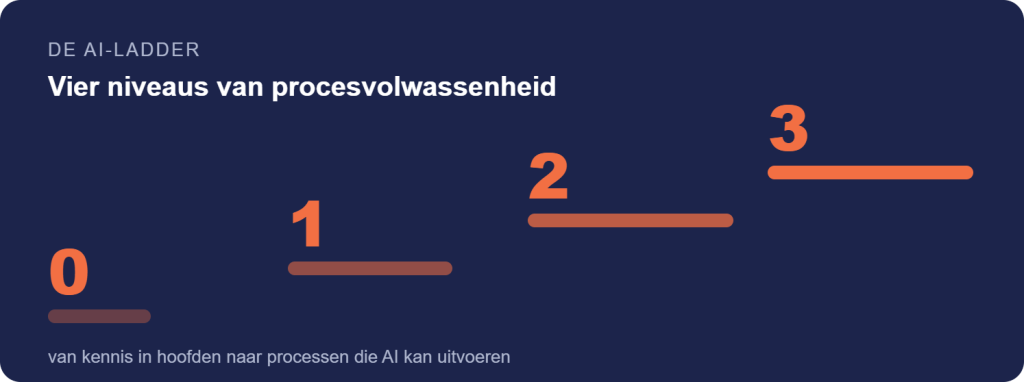
The Four Levels of the AI Ladder
Place your organization on this ladder and you will know within thirty seconds what AI can realistically deliver for you at this moment.
Level 0 — the process is in people’s heads.
There is no description, or it is years old and no one follows it. AI only delivers individual productivity here. No business results, no business case. Almost all stalled pilots start here.
Level 1 — the process is described in text.
A manual, a work instruction, an ISO folder. AI can search, summarize, and answer questions within this. It cannot execute: the text contains no decidable rules.
Level 2 — the process is modeled.
Roles, decision rules, exceptions, data, and systems are explicit. AI can assist in thinking and preparation. Equally important: the scope is defined and the business case is calculable.
Level 3 — the process is modeled and measured.
Lead time, volume, error rate, and handovers are known per step. AI takes over tasks with demonstrable value and controllable risk. This is where the 37% reside.
Most organizations doing “something with AI” are at level 0 or 1 and buy technology that assumes level 2 or 3. That is the entire explanation for the meeting at the beginning of this piece.
What Has Been Added Since August 2, 2026
For those deploying AI in a process with consequences for people — recruitment and selection, credit assessment, access to services, safety-critical production — there is a second reason, and it is not optional.
On August 2, 2026, the obligations for high-risk AI systems under the European AI Act came into effect. They require a risk management system across the entire lifecycle, technical documentation kept for ten years, logging and traceability, and demonstrable human oversight. ISO/IEC 42001 offers the same framework as a management system.
Read that list again: these are not technical artifacts; they are process artifacts. Where in the process is the system located, what decision does it make, who is monitoring it, what happens in case of a deviation — exactly the questions a process model answers and a Word document does not.
Those already running ISO 9001 have a head start that is larger than they think. The process model you maintain for your quality system is the place where this accountability lands.
This is an outline of the main points, not legal advice. Whether a specific system qualifies as high-risk is an assessment in itself.
What You Can Do on Monday
No transformation program. Three steps, and the first takes one afternoon.
1. Choose one process, and choose it well. Not the most strategic one, but the process that runs frequently, has many handovers, and which everyone knows leaks time. Procure-to-pay, order intake, complaint handling, onboarding. Volume creates the business case; handovers create the profit.
2. Model it to Level 2. Roles, decision rules with their criteria, exceptions as their own paths, and the systems involved. Expect to spend a day or two with the people who do the work. You will discover two things along the way: that the process runs differently than the manual says, and that at least one decision rule is not recorded anywhere.
3. Measure before you automate anything. Lead time, volume, error percentage, number of handovers. Four numbers. Without those four, you will have the exact same conversation in six months — only then with an invoice attached.
In Conclusion
Implementing AI is not a technology project that happens to involve processes. It is a process project that happens to use technology. Organizations that reverse this buy a solution and then go looking for the problem — exactly what Gartner predicts for 2027.
Your AI result is never better than your process description. Those who cannot explain their process cannot delegate it — not to a human, and not to an agent.
Do you want to know at which level your processes stand?
Bend Projects performs an AI ladder scan on one process of your choice: we model it to level 2, map the four key metrics, and provide a reasoned judgment on what AI can realistically take over here. Schedule a conversation or see how we map processes with 2c8.
Sources
- McKinsey & Company, The State of AI: Global Survey, August 25, 2026
- Gartner, “Over 40% of Agentic AI Projects Will Be Canceled by End of 2027”, June 25, 2025
- Regulation (EU) 2024/1689 (AI Act), high-risk obligations in effect as of August 2, 2026
- ISO/IEC 42001, AI management system
- CBS, Companies use AI most often for marketing or sales, 2025
- MIT NANDA, The GenAI Divide, 2025 (the “95%” claim, methodologically controversial)
Frequently Asked Questions about Implementing AI (FAQ)
What does implementing AI mean in practice?
Implementing AI is not a technology project that happens to involve processes, but a process project that happens to use technology. In practice: choose one process, make it explicit in a model with roles, decision rules, exceptions, and systems, and only then determine which step you assign to AI.
Why do so many AI pilots fail?
Gartner predicts that more than 40% of agentic AI projects will be canceled before the end of 2027 for three reasons: rising costs, unclear business value, and inadequate risk management. None of those three is a technical question — they are process questions, asked after the technology had already been purchased.
What is the AI ladder?
The AI ladder categorizes into four levels what AI can realistically do with your process. Level 0: the process is in people's heads. Level 1: it is described in text. Level 2: it is modeled. Level 3: it is modeled and measured. Most organizations are at 0 or 1 and buy technology that assumes 2 or 3.
Do I need to describe my processes before I deploy AI?
Description alone is not enough. An AI agent can do nothing with prose: "the buyer reviews the request and forwards it where necessary" leaves open who, based on which criteria, and in which system. You need a model in which roles, decision rules, exceptions, and systems are explicit.
What does the European AI Act change for my processes?
Since August 2, 2026, obligations for high-risk AI systems have applied: a risk management system across the entire lifecycle, technical documentation kept for ten years, logging and traceability, and demonstrable human oversight. These are process artifacts, not technical ones. This is the main outline, not legal advice.
How long does it take to make one process AI-ready?
Expect to spend a day or two with the people who do the work to model a process to level 2. After that, you measure four numbers: lead time, volume, error percentage, and number of handovers. Only with those four is the business case calculable and the risk controllable.


